Bavikonda Buddhist Complex Guide
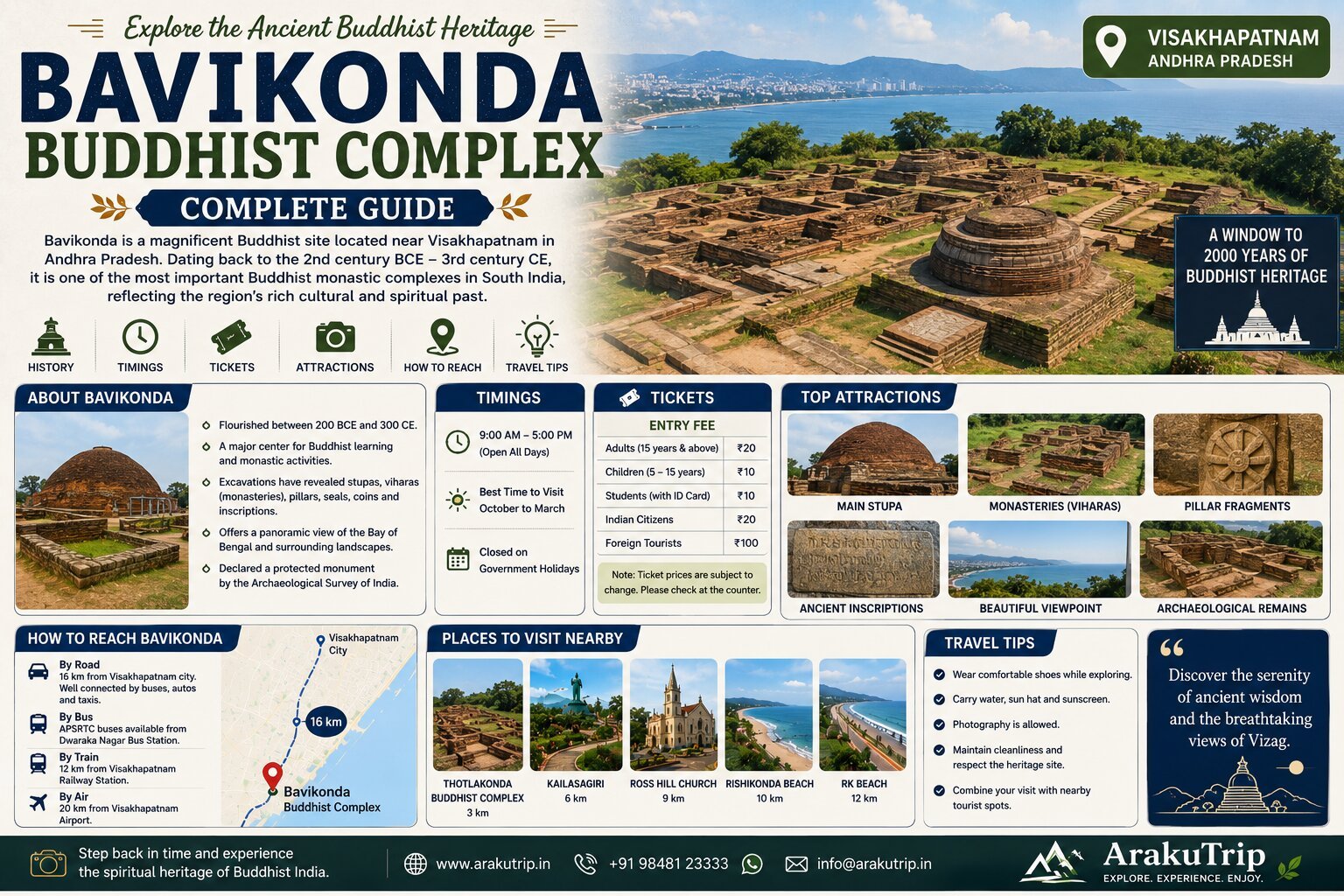
Bavikonda Buddhist Complex Guide
Visakhapatnam · Ancient Ruins Guide
Bavikonda Buddhist Complex: The Complete Visitor Guide
A 2,000-year-old ruined Buddhist monastery on a hilltop overlooking Vizag’s coast — stupas, chaityas, viharas and honest tips from the ArakuTrip team.
Quick answer
This Bavikonda Buddhist Complex Guide covers the ruins of an ancient Buddhist monastery roughly 2,000 years old, sitting atop a hilltop near Visakhapatnam’s airport road with sweeping views over the surrounding coastline. Archaeological excavations uncovered stupas, chaityas (prayer halls) and viharas (monastic dwellings), along with relic caskets pointing to the site’s genuine spiritual and historical significance dating back to around the 3rd century BCE. A small entry fee applies, and the hilltop setting adds scenic value to what is already one of the region’s most important ancient Buddhist sites.
Bavikonda Buddhist Complex: Key Facts at a Glance
About Bavikonda Buddhist Complex: History & Significance
This Bavikonda Buddhist Complex Guide covers one of the most historically significant ancient sites near Visakhapatnam — the ruins of a Buddhist monastery roughly 2,000 years old, sitting atop a hilltop near the city’s airport road with commanding views over the surrounding coastline.
Archaeological work at the site has uncovered stupas, chaityas (prayer halls) and viharas (monastic dwellings), painting a picture of a once-thriving monastic community that occupied this hilltop centuries before the modern city grew up around it.
Excavations also uncovered relic caskets at the site, adding genuine archaeological and spiritual weight to Bavikonda’s significance — a discovery that places it among the more important Buddhist heritage sites on India’s eastern coast.
For a contrasting living religious site nearby, see our Simhachalam Temple guide. For the official regional tourism perspective, see the Andhra Pradesh Tourism website.
Excavations & Relics
Archaeological excavations at Bavikonda have revealed a monastic complex dating from around the 3rd century BCE through the 2nd century CE, a span of several centuries during which the site served as an active Buddhist religious and educational centre.
Among the most significant finds were relic caskets, believed to contain remains associated with Buddhist practice, discovered during formal excavation work — a discovery that elevated Bavikonda’s importance well beyond a simple set of ruins into a genuine site of archaeological and spiritual significance.
Why You Should Visit Bavikonda Buddhist Complex
Bavikonda offers a genuinely different historical experience from Vizag’s coastal and naval attractions — a chance to see 2,000-year-old ruins that predate the city’s modern identity by many centuries.
The hilltop setting adds real scenic value alongside the historical interest, with views over the surrounding landscape rewarding the walk up to the site.
For visitors with a specific interest in Buddhist history or Indian archaeology, this is one of the more significant sites on the entire eastern coast, and genuinely worth the moderate drive from the city centre.
Top Things To Do at Bavikonda Buddhist Complex
Explore the stupa ruins
See the remains of ancient Buddhist stupas central to the monastery’s religious life.
Walk through the vihara dwellings
Explore the remnants of monastic living quarters that once housed the resident community.
Visit the chaitya prayer halls
See the ruins of the halls once used for communal prayer and gathering.
Take in the hilltop views
The elevated position offers pleasant views over the surrounding landscape.
Read the informational signage
Context on the site’s history, excavation and significance is provided throughout the complex.
Photograph the ancient ruins
The weathered stonework against the hillside makes for genuinely striking historical photography.
Best Time to Visit Bavikonda Buddhist Complex
Short answer: a weekday morning between October and February, when the walk across the exposed hilltop site is most comfortable.
Winter (Oct–Feb)
The most comfortable season for exploring the exposed hilltop ruins.
Summer (Mar–Jun)
Hot and exposed; visit early morning and carry plenty of water.
Monsoon (Jul–Sep)
Green surroundings, but check for slippery paths on the hillside.
Time of day
Morning light works well for photographing the ruins before the day heats up.
Check current hours before visiting, since archaeological site schedules can vary.
How To Reach Bavikonda Buddhist Complex
By Air
Visakhapatnam International Airport (VTZ) is close by, given the site’s proximity to the airport road — roughly 10-15 minutes by road.
By Train
Visakhapatnam Junction (VSKP) is about 12-16 km away, roughly 30-40 minutes by taxi.
By Bus
Limited direct bus connectivity; a car or cab is the more reliable option.
By Car
A straightforward drive near the airport road, with parking available at the base of the hill.
Local Taxi & Google Maps
Search “Bavikonda Buddhist Complex Visakhapatnam” — it pins accurately.
An ArakuTrip local Vizag cab can handle the round trip and wait through your visit if needed.
Live flight status for Visakhapatnam International Airport (VTZ) is available on the official Airports Authority of India site, and train times can be checked on Indian Railways.
Weather & Safety Guidelines for Bavikonda
The site’s exposed hilltop location makes sun protection and hydration especially important, particularly during summer months.
Wear sturdy footwear given the uneven, ancient stonework across the site, and take care on any inclined paths, especially after rain. Check current forecasts on the official India Meteorological Department site before visiting during the monsoon season.
Nearby Attractions Near Bavikonda
Bavikonda’s location near the airport road puts a few other notable stops within a moderate drive.
Simhachalam Temple
An ancient hilltop temple with distinctive Kalinga architecture, offering a living-faith contrast to Bavikonda’s ancient ruins.
Indira Gandhi Zoological Park
One of India’s largest zoos by area, a moderate drive from Bavikonda.
Kailasagiri Hill Park
A hilltop park with a ropeway and panoramic city views, a further drive toward Beach Road.
Ross Hill Church
A historic hilltop church with its own city views, a moderate drive toward the city centre.
Bavikonda Buddhist Complex Photography Guide
The weathered stone stupas and vihara ruins against the hilltop backdrop offer genuinely striking archaeological photography, particularly wide shots capturing the full scale of the ancient complex.
Golden hour: morning light brings out the texture and detail in the ancient stonework particularly well.
Composition tip: the surrounding landscape visible from the hilltop adds valuable scale and context to close-up ruins shots.
Food Near Bavikonda Buddhist Complex
No food stalls operate directly on-site, so carry water and snacks, especially for a longer visit or a warm day.
Plan a proper meal back toward the city centre or airport road area before or after your visit.
Suggested Itinerary for Bavikonda Buddhist Complex
Quick Visit (1-2 hours)
Explore the main stupa, vihara and chaitya ruins, then continue with your day.
Combined Faith & History Day
Pair Bavikonda with Simhachalam Temple for a day exploring the region’s varied religious heritage.
Airport-Adjacent Stop
Given its proximity to the airport road, this works well as a stop on the way to or from a flight with time to spare.
Bavikonda Buddhist Complex Budget Guide
Treat these as indicative 2026 figures — confirm current entry fees on-site.
Bavikonda Buddhist Complex: Travel Tips & Common Mistakes
Packing checklist
- Sturdy footwear for uneven ancient stonework
- Water and snacks, since none are sold on-site
- Sunscreen and a hat for the exposed hilltop
- Cash for entry and any camera fee
- A camera for the ruins and hilltop views
Common mistakes to avoid
- Visiting at midday in summer without water or shade
- Climbing on or touching fragile ancient stonework
- Not checking current hours before making the drive
- Underestimating the walking involved across the hilltop site
- Rushing through without reading the informational signage
Responsible Tourism at Bavikonda Buddhist Complex
Avoid climbing on or touching the ancient stonework — these ruins are fragile and irreplaceable, and casual contact accelerates wear that centuries have already taken their toll on.
Carry out any rubbish, since the site has no on-site waste facilities. For broader responsible-travel guidelines on India’s heritage sites, the Ministry of Tourism, Government of India is a useful reference.
Bavikonda’s Place in India’s Buddhist Heritage
Bavikonda is part of a small cluster of ancient Buddhist sites scattered across the hills near Visakhapatnam, evidence that this stretch of the Andhra coast was once a genuinely significant centre of Buddhist learning and practice, long before it became known for beaches and naval history. Few visitors arrive in Vizag expecting to find 2,000-year-old monastic ruins, which is part of what makes stumbling onto this history so rewarding.
The scale of the original monastic community, inferred from the number and layout of excavated structures, suggests Bavikonda supported a sizeable population of monks over several centuries — a detail that’s easy to overlook when walking past low stone foundations that, at first glance, might not seem to amount to much. Comparable sites elsewhere in India have drawn far more scholarly attention and tourist footfall, which makes Bavikonda’s relative obscurity something of a quiet advantage for visitors who prefer exploring history without crowds.
Taking the time to read the on-site signage and understand what each set of ruins represented in active use transforms the visit from a quick photo stop into a genuinely absorbing piece of ancient Indian history, hiding in plain sight just outside a busy modern city. Few travellers plan their Vizag trip around it, but those who make the short detour rarely regret the extra hour or two.
Bavikonda Buddhist Complex: Frequently Asked Questions
How old is the Bavikonda Buddhist Complex?
The monastic ruins date back roughly 2,000 years, to around the 3rd century BCE through the 2nd century CE.
What can I see at Bavikonda?
Ruins of stupas, chaityas (prayer halls) and viharas (monastic dwellings) from an ancient Buddhist monastery.
Is there an entry fee at Bavikonda?
Yes, a small nominal entry fee applies.
How do I reach Bavikonda Buddhist Complex?
It sits on a hilltop near the airport road, a moderate drive from central Visakhapatnam.
What relics were found at Bavikonda?
Archaeological excavations uncovered relic caskets believed to contain remains associated with Buddhist practice.
Is Bavikonda a Buddhist pilgrimage site today?
It functions primarily as a historical and archaeological site today rather than an active site of worship, though it still carries spiritual significance for many visitors.
How long does a visit to Bavikonda take?
Most visitors spend 1 to 2 hours exploring the site.
Is photography allowed at Bavikonda?
Yes, exterior photography is generally allowed and encouraged, given the site’s photogenic ruins.
Is there parking at Bavikonda?
Yes, parking is available near the base of the hill.
Is food available at Bavikonda?
No, there are no food stalls on-site — bring your own water and snacks.
Is Bavikonda suitable for children?
Yes, with supervision — the uneven ancient stonework and some walking make it better suited to older children.
Can I combine Bavikonda with Simhachalam Temple?
Yes, both sit within a moderate drive of each other and offer a contrasting look at the region’s religious history.
Is Bavikonda wheelchair accessible?
The uneven, ancient terrain across the hilltop site makes wheelchair access challenging in most areas.
Are guided tours available at Bavikonda?
Signage guides most self-paced visits; check on-site for any guided options currently offered.
Why is Bavikonda historically significant?
It represents one of the more important ancient Buddhist monastic sites on India’s eastern coast, with excavated relics adding genuine archaeological weight.
Is Bavikonda crowded?
Generally no, it sees fewer visitors than Vizag’s beaches and museums, making for a relatively quiet, contemplative visit.
Is mobile network coverage reliable at Bavikonda?
Coverage is generally reliable given the site’s proximity to the airport road.
Are there other ancient Buddhist sites near Vizag?
Yes, the wider region has other ancient Buddhist sites; check locally for current details on nearby excavated locations.
Do I need a guide to appreciate Bavikonda?
Not necessarily — informational signage throughout the site provides useful context for a self-guided visit.
Is Bavikonda worth visiting if I have limited time in Vizag?
Yes, especially for visitors interested in ancient history and archaeology, alongside the city’s more contemporary coastal attractions.
What is the best time of day to photograph Bavikonda?
Morning light brings out the best detail and texture in the ancient stonework.
Planning to Explore Vizag and Araku?
Bavikonda pairs naturally with a wider heritage-focused day or a longer Vizag-to-Araku trip. ArakuTrip handles local Vizag cabs, Vizag-to-Araku tour packages, family and couple itineraries, hotel and tent-stay bookings, all coordinated by a local team who knows both the coast and the hills.
📞 WhatsApp: +91 98549 75497 · 🌐 arakutrip.in
Related Attraction Guides

All Categories
- Araku Cab Service
- Araku Coffee
- Araku Tour Packages
- Araku Tourist Places
- Araku Trip Packages
- Araku Valley for families
- Araku Valley shopping
- Araku Valley Timings
- Araku Valley Trip Cost
- Araku Weather
- Around Vizag
- Camping in Araku Valley
- Hidden Spots
- Hotel & Rooms
- Hotels & Resorts
- Stay & Food
- Tatipudi Reservoir
- Tent camping
- Transport & Safety
- Travel Guides
- Vizag Attractions
- Vizag Beachs
- Vizag Cab Services
- Vizag Travel Planning
Recent Posts

Vizag Travel FAQ

Vizag Photography Guide

Vizag Shopping Guide
Tags